Showing posts with label Think Humanity. Show all posts

Sunday, March 18, 2012

MaNdate 12 Bed Net Distribution in Uganda


Saturday, February 4, 2012

A basic purpose -- the gift of power!

My wish is to celebrate my birthday with a purpose. A basic purpose -- the gift of power to Think Humanity!
For the past three years in February, I have asked for your help to raise money for Think Humanity for my birthday. This year is especially important to me.

In May 2011 we opened a health care center in Uganda; the Think Humanity Community Health Centre.


It is registered with the Ministry of Health -- a wonderful place where the most disadvantaged (refugees and underdeveloped rural communities) can receive good, quality health care for free.
In July 2011 while in Uganda I experienced something heartbreaking. While we have a wonderful 24 hour service, the power in this area goes out for days at a time. There was a call late at night so I decided to go along with the doctor to the THCHC.

A young pregnant woman was suffering terribly with malaria. She had a high fever and was crying for her baby to live. She was afraid that she would have a miscarriage. It was pitch dark - no power, only the flashlight that I carried. I had to hold the flashlight for the doctor as he put an IV into the back of this young woman's hand.

While holding the flashlight I was looking around the room with tears in my eyes. First, I will say that I was grateful that we could even have this service to save lives, but secondly I feared for this woman and her baby. Life's challenges are enough in East Africa, but to also deal without power was another unthinkable challenge. I became very frustrated that we did not have a backup power source.

That is why I am fund-raising for my birthday to raise money for a solar panel that will provide electricity to the clinic, but also will keep reagents (chemicals for lab testing) from spoiling in the lab fridge. If we can have a reliable source of power, we can keep immunizations in the lab fridge and help more children.

This week we have had reagents spoil due to a power outage - we have lost enough reagents that could have helped 30 people!

I could tell you more reasons why this alternate power source is necessary, but I believe it stands on its own.

Won't you please donate towards a solar panel for our clinic in Uganda in honor of my birthday?
My wish is to celebrate my birthday with a purpose. A basic purpose -- the gift of power!
"To help save lives and provide hope for refugees and underdeveloped communities in Africa by improving provisions for healthcare, clean water, education and socio-economic development."


Beth Heckel, Think Humanity Director/Founder

To give to or share Beth Bevard Heckel's Birthday Wish, follow the link below:

http://wishes.causes.com/wishes/439790?bws=email_to_friends&m=1ac83f93

or visit the Think Humanity website http://www.thinkhumanity.org/donate.html

Sunday, December 18, 2011

Get Girls Into School - Think Humanity

THINK HUMANITY - GET GIRLS INTO SCHOOL

Shown are girls from the Kyangwali Refugee Camp that have benefited from the hostel/education in 2011
 The Think Humanity Girls’ Hostel begins a new year in January 2012 and will bring 30 new girls from refugee and underdeveloped communities together under one roof, where they will have access to secondary education.
Without the opportunity to study further, these children are likely to get married at a young age, earn low incomes, have large families they cannot support, and thus continue the cycle of poverty and under-development.

This project attempts to break that cycle. The children will not only gain access to secondary education, but they will be supported through additional tutoring, educational seminars, entrepreneurship skills training, leadership development, physical activities/sports, access to health care, and peace-building activities.
Our goal is not simply to give girls an education, but to give them the skills and tools necessary to succeed in life and give back to their communities. After all, they know their communities and the problems better than we do.

Of course, a project like this takes money. Education is a long term investment that requires initial capital – but the outcome is worth it. Education, and particularly female education, is a proven way for countries to develop and reduce poverty.

Please help us to educate young girls. We will have a link up soon where you can meet all our girls. Most of them are orphans, some have one parent, but all are waiting for this opportunity of a lifetime. -Charity Watson, Project Sponsor

What it will cost to sponsor a girl in 2012.
2012 Girl Education Cost Breakdown

Rent $75.00

Health Care $30.00

Transportation $25.00

Uniform $15.00

Firewood/Water/Electricity $10.00

Food Support $25.00

Books/School Supplies $20.00

Total for 2012 $200.00
Think Humanity will cover other expenses such as toiletries, IDs, cook, initial expenses such as beds, cooking utensils, furniture for study room and library and any overages/unforeseen expenses.


Funding for a student can be made in one payment or in installments.

Visit this fundraising link to Donate to "Get Girls Into School",


or Think Humanity, 2880 Spring Mountain Dr. Loveland, CO 80537

"The world may be better because you made a difference in the life of a child."


"Education for girls has been identified as one of the best solutions to reversing the relentless trend of poverty and disease." - UN Chronicle

Thursday, December 1, 2011

What Bono Taught Me About AIDS and Justice (World AIDS Day)

What Bono Taught Me About HIV/AIDS and Justice


In 2006 I had the opportunity to attend a Global Leadership Summit that was hosted by the Willow Creek Association.

Bill Hybels, founding pastor at Willow Creek Community Church interviewed Bono. Bono, an Irish rockstar? This combination seemed interestingly odd, yet ended up being a life-changing experience for me; an eye-opener to poverty and the AIDS epidemic in Africa.

He commented on how the church had been inexcusably late to the game at fighting poverty and treatable diseases, adding that people are judgmental about the AIDS virus. Bono gave an example: If you came up to a car accident and the injured driver was drunk, do you help him or judge him and let him die? No, we have to act!

Bono said, “Love thy neighbor is not advice. It’s a command. In a global community, the poor and the disadvantaged in Africa are our neighbors." He quoted Matthew 25:45: “Whatever you did not do for one of the least of these, you did not do for me."

He added, "Our purpose is to bring Heaven to Earth. The world is not a happy place for most people living on it." Bono wrapped it up with this statement: "Your charity is important, but your passion for justice is needed. I'm asking for your voice and for you to give permission to fix these problems that are fixable. It's not a burden, it's an opportunity...it's an adventure."

Within a year, Think Humanity became a nonprofit organization and our adventure began!

Think Humanity has done what little we can with our resources to help with AIDS sufferers in Uganda, but we can do more. Other clinics in Hoima charge $6 for a lab testing strip, but we provide this service free to those who cannot pay. When we do charge, it is only equal to the manufacturer's price of $2.

Think Humanity has held special meetings in Kyangwali Refugee Camp with the people that are suffering with HIV/AIDS. Some of the things we have done is to listen to their problems, which gives them hope and encouragement. We also give them items such as mosquito nets, soap and salt.

If you wish to help make a difference on World AIDS Day
1) learn more facts,
2) volunteer to help with a local organization (In Northern Colorado there is NCAP) or
3) a small donation to Think Humanity for test strips, bed nets or soap.
4) or to organizations, such as Global Fund.
Enjoy this day of remembrance and awareness, but know that beyond this day, any hope for a better world is to work towards compassion, love and fairness for all people regardless of where they live, what they do and who they are. - Beth Heckel, Think Humanity Founder

You ARE your brother's keeper and "We must learn to live together as brothers or perish together as fools." -Martin Luther King, Jr.

www.ThinkHumanity.org


The above photo was taken in Kyangwali Refugee Camp during a day of hope for HIV/AIDS sufferers.


Tuesday, June 21, 2011

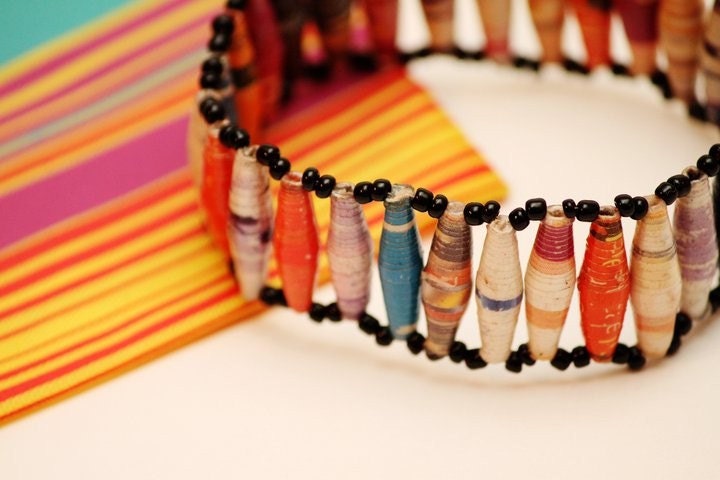
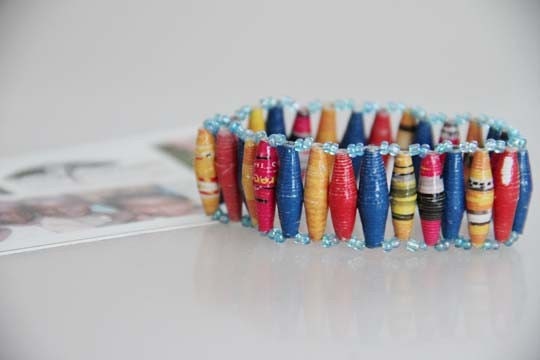
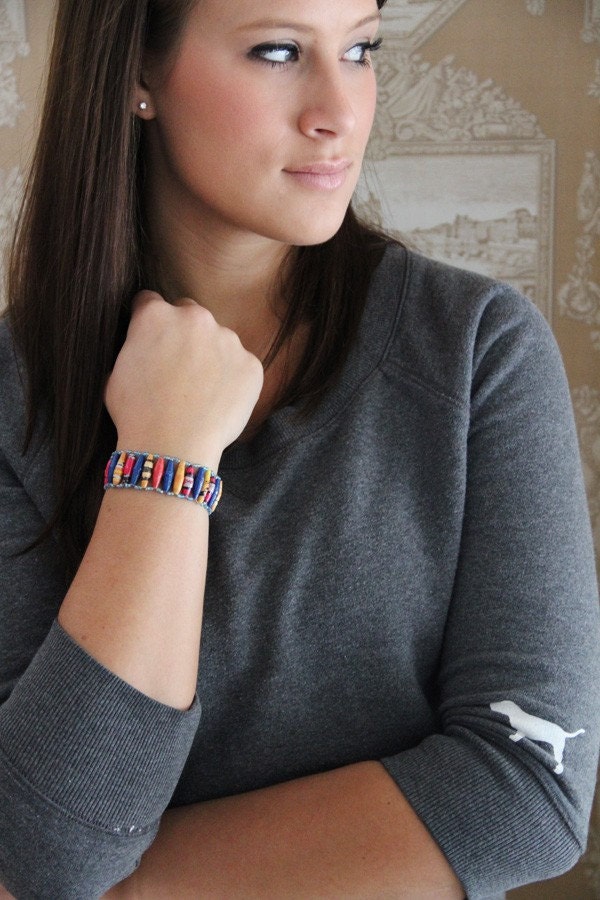
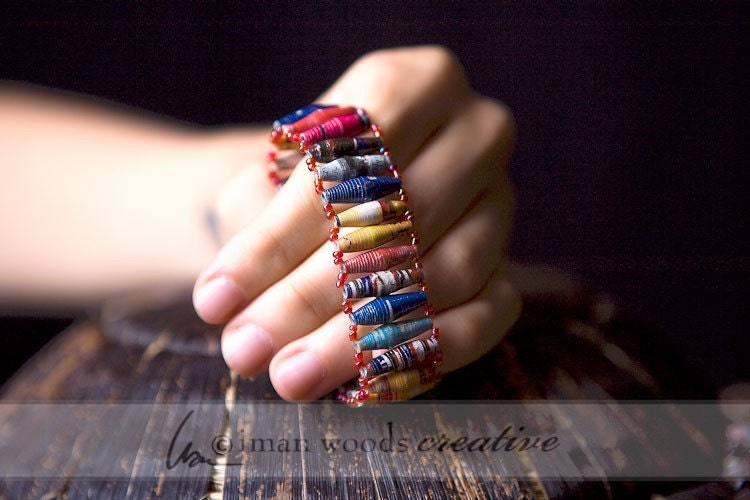
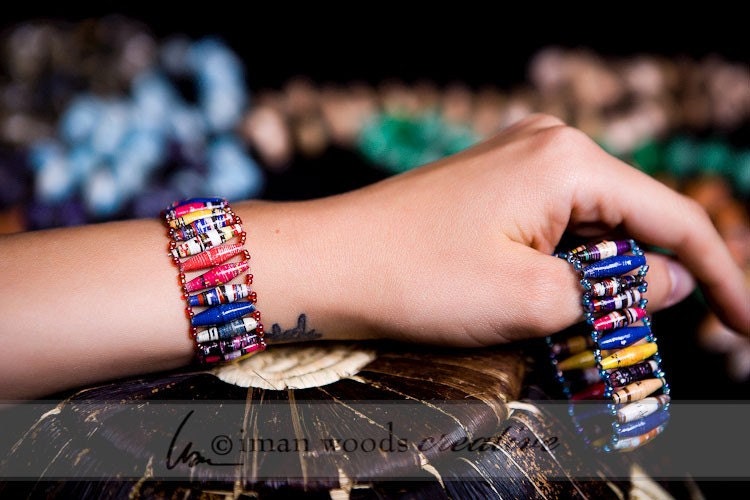
Uganda Recycled Paper Bead Bracelet Africa Fair Trade

http://previewitem.ebay.com/ws/eBayISAPI.dll?PreviewItemV4&SessionId=120887801203&SeqId=5817740&md=1&noPreviewHeader=1
Acholi Bracelet Band, recycled paper

Check out ebay for jewelry sales. Hope to sell all ten of these before we leave for Uganda. It's difficult when we are away because we lose money that we could be earning to pay for medication, doctors, nurses and lab technicians.

Acholi Bracelet Band, recycled paper
Picture credits to Sam Rogers and Iman Woods.
Each multi-colored band bracelet is uniquely made and no two beads are the same. The bracelets pictured may be slightly different than what you receive.The size varies, so please specify whether your wrist is small, medium or large. The band bracelet is made from recycled paper beads with blue, red or black glass beads between the paper beads. Visit the website for more information at www.Thinkhumanity.org.
Note: It is best to keep your beaded jewelry from getting wet. They are water resistant, but not water-proof, which means that splashing when washing will not hurt them, but dipping into water over a period of time can cause them to become sticky. If your items breaks, please let us know and we will make it right. We cannot fix your jewelry because they are made in Uganda, but we will do our best to replace it with something similar.
************************************************************

Think Humanity has partnered with a group of women from Uganda that live in the Acholi Quarter Camp for Internally Displaced Persons. We personally know these women. We are not simply purchasing jewelry in local shops or at the airport like many do. These women are making beads to help earn family income and sustain a community financed food-aid program for their children. We purchase the jewelry from them and they benefit, but then we sell in the USA at a reasonable profit. 100% of the money then goes back to help with Think Humanity projects. It will then benefit those refugees displaced from war-affected countries living in Uganda in refugee settlement camps.

We are helping to build a small economy in Uganda, but at the same time helping our own self-sustainable projects in refugee camps.

************************************************************

The jewelry is made out of tightly rolled colored recycled paper. For example, the women receive donated outdated corporate calendars to use for their paper beads.

http://www.thinkhumanity.org/
By purchasing Acholi products you are helping refugees in IDP and UNHCR camps.

How Think Humanity identifies Fair Trade:

1) Fighting poverty;
2) Building sustainable businesses;
3) Empowering women;
4)Supporting education; and
5) Helping the environment by recycling.

or visit the Etsy Store at www.etsy.com/shop/ThinkHumanity
 

Thursday, May 5, 2011

Dying Slowly; how life goes in a refugee camp. Kyaka II Refugee Camp

An article on Kyaka II Refugee Camp, a camp where Think Humanity has been working to improve conditions for refugees. In 2011 we have built two clean water wells, distributed bed nets, gave birthing kits, shoes and school supplies. To help us in Kyaka II, please visit the website and donate. Specify where you would like your donation to go. http://www.thinkhumanity.org/donate.html
Donate Now

Kampala (Uganda), August 2009. Kyaka II refugee settlement lays on a vast area amidst the lush and green-painted hills of western Uganda. This is home to roughly 16,000 refugees, mostly coming form the DRC, Sudan and Rwanda. These people are part of the 31 million under the formal responsibility of the UNHCR: the size of an average European country, a country without borders and without official representatives.

Young refugees - Kyaka II Refugee camp, Uganda

Joseph has been living in Kyaka II for nine years, his degree has no recognition in Uganda so he cannot work. He sleeps under a hut that he made himself with wood and mud and covered with a piece of white plastic provided by the United Nations, just like any other hut around the camp. The United Nations also give him a monthly ration of maize flour and rice, which is only enough for the first three weeks. Joseph manages to find the rest by digging the small maize field he was assigned, the economy here is exclusively rural. I ask him how he arrived in Kyaka II: he escaped on foot for 500 Kilometers through the Congolese forest; half of his family was taken away by war and he lost contact with the other half after a fire destroyed the hut he lived before, burning his address book and mobile phone. Joseph tells his story calmly, as if he is talking about someone else.


Central-Eastern Africa has been hit by two of the most violent conflicts in the recent history of the continent: the Rwandese 1994 genocide and the Second Congo War, which, not surprisingly, is best known as Africa’s World War. As a result, Kyaka II, like other camps in the area, is melting pot of people from different backgrounds, languages and cultures. It is a potentially explosive mix of victims and murderers, rapists and innocents. The overall community does not seem to decrease, as recent fights in the North Kivu and in Kenya following the 2007 elections are securing fresh inflows of refugees. Since most of the people inside the camp lost their family ties and bonds, traditional networks of support are being replaced by fragile and shaky newly-built household networks. This is a reason why social cohesion is not strong enough to provide support to everybody and prevent conflicts.
Many refugees, especially women, are nevertheless trying to work together and see themselves as being all on the same boat, helped by humanitarian projects carried on in the camp. For instance, a group of two dozens of women is making sanitary pads in a small factory funded by the UNHCR. Unfortunately, such kind of projects are too few and uncoordinated to effectively help the whole community.

What strikes me more about refugees’ life is the extreme shakiness they are forced into. In one of the tiny villages of the settlement live some Rwandese families, their kids are scratching about at the time they are supposed to be at a camp school, in one of those classrooms with one teacher and one hundred pupils. I ask their parents about it, and their answer, faultless and logic, sounds something like: “We are waiting to be repatriated, it makes no sense to pay the school fees if we are going back to Rwanda soon.” The problem is that none of them was told the day of repatriation, it could be a matter of two months or two years. Hence, for two months or for two years, their kids are not going to school.

Refugee woman, Kyaka II Refugee camp, Uganda

The existence of refugees entirely depends on the intermittent and unpredictable repatriation arrangements between the government of their home country, the Ugandan officials and the United Nations. Planning a future in Uganda is impossible for them: finding a job outside the camp (the necessary condition to exit from it) is too hard, not to talk about achieving the Ugandan citizenship. So, most of them remain inside the settlement, where at least they have their food ration. Unfortunately, for many of them, life inside the camp can turn into a hell.

Patrick, for instance, is a 32 years old man who escaped from the North Kivu. As he reached the Ugandan border, he was put on a UNHCR vehicle and taken to Kyangwale refugee camp, where he found the very persons that killed his parents and burnt his house back in the Congo. They threatened him to death and they burnt his hut, forcing him to sleep every night in a different place. After months, he succeeded to be transferred to another camp: he is now in Kyaka II. However, Patrick is not feeling safe even here, he wishes he could escape to a new country. His voice trembles as he tells me that he is trying not to reveal his origin to anyone, but such a discretion is impracticable here, and intrinsically dodgy. Anyway, between one escape and the other, he found the time to get a wife, but it didn’t work out for the best: he chose a woman from a different ethnic group, which made him lose the support of his companions.

Safety problems like the ones of Patrick are quite common inside the camp, together with rapes, robberies and arsons. For this reason, the settlement administration was recently entrusted to a military commandant, who gets his wage from both the Ugandan government and the UNHCR. No accident, then, that all Ugandan refugee settlements are built next to military bases.


Outside the commandant office I meet Baunda, a Congolese man from the South Kivu who has been living in Kyaka II for a whole fifteen years. The camp, he tells me, is like a prison without locks and gates, where life is in a state of oblivion. I dare to ask him to compare his life in the Congo with the one in the camp. This is his answer: “I had to make a choice: staying in the Congo and dying suddenly or escaping and dying slowly. I chose to die slowly.”

Dying slowly: how life goes in a refugee camp


In Africa, Migration on January 11, 2010 by admin Tagged: Africa's world war, Kyaka II, North Kivu, refugee camp, Uganda, United Nations
http://www.istoriai.info/2010/01/dying-slowly-how-life-goes-in-a-refugee-camp/

Saturday, April 17, 2010

World Malaria Day - April 25th, 2010


April 25th is World Malaria Day.
Think Humanity works in sub-Saharan Africa to provide refugees with mosquito nets. In this part of Africa a child under the age of 5 years dies from malaria every 30 seconds, but it is preventable when we provide them with an insecticide treated bed net for only $5 each. Most people can afford to help save the life of a child. The net lasts 3-5 years and several children can sleep under it. Just think about it before World Malaria Day. You can donate $5 and make a big difference in the world. Reach out to others. Think Humanity.

Monday, March 1, 2010

Jewelry and Java for a Reason


March 13, 2010
5 to 8 pm
Come have a latte, shop for jewelry and help the refugee women of Uganda!
Solid Grounds Coffee Shop will be hosting a night of jewelryand fun promoting beautiful jewelry made by women in Africa. The beads are made out of recycled paper and all the proceeds go to Think Humanity and their work with refugees in Africa.
You can make a difference and help these women and their families.
Solids Grounds Coffee Shop
6504 S. Broadway
Centennial, Colorado 80121
Host: Becca Strait
Contact Becca at Becca@Nightlight.org 303-870-8661
We should also have handmade Acholi African baskets, sling purses and smaller purses for sale.
By purchasing the jewelry from the Acholi women it allows them to purchase food and to educate their children. We then send 100% from sales back to Think Humanity projects.
A portion of money raised will go towards helping girls' education by purchasing ground nuts and cabbages to provide them with a healthy diet.
Presently they are eating only posho, porridge made from maize flour.
Thank you for your support.
Video on YouTube of Acholi woman working in rock quarry in IDP camp.